I am a narcissist.
After my Media and Society paper about narcissism on Facebook, I realized that I have all the tell-tale signs of a narcissist. I talk about myself. I am frustrated when people don't honor me the way I think they should. And in the midst of my self-loving is self-loathing - I want to be more than I already am.
It's a big mess.
It's also something I've been praying against since the spring.
My goal for this internship was to rid myself of narcissism. I wanted, and still want, a character arc. I want my character - me, Lauren Deidra Sawyer - to change during this internship, and for the better.
I wanted to magically become more others-focused and compassionate.
I wanted to overcome my insecurities and view myself soberly.
It's about four weeks into my internship, and I think it's finally happening, just not in the way I had imagined. I thought that I'd start stripping myself of narcissism when I met a bunch of sick kids or toughed the 115 degree heat. But honestly, I'm being challenged the same way I am in the States.
Note that I'm glad I'm going through this. I don't want my dear PLC family to think that they're doing anything wrong. Everything that's going on is for the best - I believe it. I won't be able to shake this narcissism without fire.
Observations:
- I am most comfortable in a leadership position ... so I find myself in a country where women aren't meant to lead. I'm forced to be okay with that.
- I'm not the best. Esther's the journalist. Lydia's the artsy one. Claire's the funny one. Sophie's Wonder Woman. I'm just me. A me that isn't "winning" at the moment.
- The task I chose for the summer does not bring me instant gratification. I am one of the few interns that took a long-term project. I am making headway on my assignment - PLC's year-end review, kind of like a magazine - but it's not as though what I'm writing is posted on the blog. It's hard. That's the one thing I love about working at a newspaper - I can see results by the end of the week.
- To somehow make this vague and mysterious: it's hard talking (I mean "talking") to a boy when you're a narcissist. It's easy for me to talk about myself all the time, but that's not how you attract the opposite sex.
Oh God, break me down.
I read this prayer in Elise and Sarah's copy of "The Pursuit of God" by A.W. Tozer:
Oh God, I have tasted Thy goodness and it has both satisfied me and made me thirsty for more. I am painfully conscious of my need of further Grace. I am ashamed of my lack of desire. O God, the Triune God, I want to want Thee; I long to be filled with longing; I thirst to be made more thirsty still.
Show me Thy glory, I pray Thee that so I may know Thee indeed. Begin in mercy a new work of love within me. Say to my soul, "Rise up, my Love, my fair one, and come away." Then give me Grace to rise and follow Thee up from this misty lowland where I have wandered so long.
Ezekiel

LinkWithin

Saturday, June 19, 2010

Tuesday, June 15, 2010
Life in Iraq: education
Yesterday afternoon, Claire and I visited Zeba and Amir in their office, two floors below the Preemptive Love office. One of Zeba's friends was at their shop and we conversed with him about womanhood in Iraq, life in Texas, PLC, autism and education.
He told us that when he was a student, back in the 1980s, the schools were very good and his teachers very knowledgeable. Coincidentally, this was during Saddam Hussein's regime.
Claire and I were confused: why would Saddam invest in education - especially for Kurds - when he was such a tyrant? We thought that most dictators liked to keep their people uneducated so they can't revolt.
We went back upstairs to an empty office - it was past five and the interns had gone home. Jeremy, our boss/friend/PLC visionary, was still around so we asked him if what our Kurdish friend said was true. After a quick Google search, we had our answer.
--
In the early 1970s during the oil crisis, when Americans were lining cars outside gas stations, handing over exponentially more money for gas than they had the previous year, Iraq was getting rich. Off of our money. This isn't a political statement, it's a fact. Because of the oil crisis of 1973, Iraq got wealthy.
Saddam Hussein, who was the vice chairman of the Revolutionary Command Council, used this newly gained money to fund domestic projects. A big part of this was the education system. He established a campaign for "Compulsory Free Education" which made all education - primary through higher ed - free. This is still true for Iraqi public schools today.
The school systems were so good that he won an award from the United Nations Educational, Scientific and Cultural Organization.
--
Today, public schooling is still free for Iraqis. It's free to go to college if your grades are good enough.
Classes are large with 25-40 students. Primary and secondary teachers aren't trained for their jobs. Teachers, like Media, whom I wrote about last week, aren't allowed to teach outside their assigned curriculum. If they are, they're punished. Students aren't punished for bad behavior like cheating, but teachers are punished for their ambition.
When we asked our ESL students if they wanted their kids to attend public schools, all but one emphatically answered, "No!"
--
So what happened? We learned from our ESL students that the public schools in Iraq are not good. How did we get from point A to point B?
Jeremy had some ideas. The Iran-Iraq War started in the early 80s. Since so much money was put into the war, not as much was put into education. The focus shifted.
Or maybe Saddam got scared, like many tyrants do, that his people would out smart him and revolt.
I'm sure there have been books written about this, or at least lengthy essays.
--
When discussing education in our ESL class, one student noted that people don't value what they don't pay for. I read an essay about this, regarding the environment. I see it as the same.
Who's going to invest time and energy into something that has no money invested into it?
Lauren
He told us that when he was a student, back in the 1980s, the schools were very good and his teachers very knowledgeable. Coincidentally, this was during Saddam Hussein's regime.
Claire and I were confused: why would Saddam invest in education - especially for Kurds - when he was such a tyrant? We thought that most dictators liked to keep their people uneducated so they can't revolt.
We went back upstairs to an empty office - it was past five and the interns had gone home. Jeremy, our boss/friend/PLC visionary, was still around so we asked him if what our Kurdish friend said was true. After a quick Google search, we had our answer.
--
In the early 1970s during the oil crisis, when Americans were lining cars outside gas stations, handing over exponentially more money for gas than they had the previous year, Iraq was getting rich. Off of our money. This isn't a political statement, it's a fact. Because of the oil crisis of 1973, Iraq got wealthy.
Saddam Hussein, who was the vice chairman of the Revolutionary Command Council, used this newly gained money to fund domestic projects. A big part of this was the education system. He established a campaign for "Compulsory Free Education" which made all education - primary through higher ed - free. This is still true for Iraqi public schools today.
The school systems were so good that he won an award from the United Nations Educational, Scientific and Cultural Organization.
--
Today, public schooling is still free for Iraqis. It's free to go to college if your grades are good enough.
Classes are large with 25-40 students. Primary and secondary teachers aren't trained for their jobs. Teachers, like Media, whom I wrote about last week, aren't allowed to teach outside their assigned curriculum. If they are, they're punished. Students aren't punished for bad behavior like cheating, but teachers are punished for their ambition.
When we asked our ESL students if they wanted their kids to attend public schools, all but one emphatically answered, "No!"
--
So what happened? We learned from our ESL students that the public schools in Iraq are not good. How did we get from point A to point B?
Jeremy had some ideas. The Iran-Iraq War started in the early 80s. Since so much money was put into the war, not as much was put into education. The focus shifted.
Or maybe Saddam got scared, like many tyrants do, that his people would out smart him and revolt.
I'm sure there have been books written about this, or at least lengthy essays.
--
When discussing education in our ESL class, one student noted that people don't value what they don't pay for. I read an essay about this, regarding the environment. I see it as the same.
Who's going to invest time and energy into something that has no money invested into it?
Lauren
Sunday, June 13, 2010
Meeting Honya and Mohammad
After Preemptive Love sends kids into heart surgery, they continue to check up on them through a program called FollowThrough. This program allows PLC to make sure the kids are adjusting to life, are healthy, and so on.
Thursday Claire, Lydia and I went on our first home visit with Jessica and Awara.
--

This is baby Honya. She had heart surgery last November. She's now 15 months old and healthy. She had a parasite a little bit ago, so she's still thin from that, but she's giggling and playing like any little one her age.
Honya's dad calls her "grandma," because she doesn't have any teeth. Toddlers her age should have teeth by now, but the heart surgery delayed her development a little.
--

Mohammad Star, whom I call the Kurdish version of my 10-year-old nephew Austin, had surgery in November. As we eat the cucumbers, fruit and pastries his mom sets out for us, Mohammad sits close next to his younger siblings, looking up at us timidly. Awara somehow gets Mohammad to talk, showing our Kurdish coworker his toy car.
Awara asks about the chickens running around outside their home. Mohammad raised 14 chickens from a hen and a rooster - all on his own!
Mohammad takes Claire, Lydia and I out to see the chickens. He and his little siblings pose for pictures - and so do we, actually - with the village and Kurdish flag waving in the background.
To get to Mohammad's house, we drove through the mountains. For someone who has lived her whole life in the flattest part of the country, seeing mountains on all sides of me, winding up a huge hill just to get to a village, seems unreal. And euphoric. It felt like I was watching a movie, not really there. Lydia compared it to being in a Bible story, us on an old felt board, a caravan through ancient Babylon.
 --
--
For all that I've done with PLC so far, this has been my favorite. Seeing the kids we've helped in the past reminds me why I spend 40 hours a week in the office. It reminds me why I try to capture the kids' stories through writing.
Lauren
* photos by Lydia Bullock
Thursday Claire, Lydia and I went on our first home visit with Jessica and Awara.
--

This is baby Honya. She had heart surgery last November. She's now 15 months old and healthy. She had a parasite a little bit ago, so she's still thin from that, but she's giggling and playing like any little one her age.
Honya's dad calls her "grandma," because she doesn't have any teeth. Toddlers her age should have teeth by now, but the heart surgery delayed her development a little.
--

Mohammad Star, whom I call the Kurdish version of my 10-year-old nephew Austin, had surgery in November. As we eat the cucumbers, fruit and pastries his mom sets out for us, Mohammad sits close next to his younger siblings, looking up at us timidly. Awara somehow gets Mohammad to talk, showing our Kurdish coworker his toy car.
Awara asks about the chickens running around outside their home. Mohammad raised 14 chickens from a hen and a rooster - all on his own!
Mohammad takes Claire, Lydia and I out to see the chickens. He and his little siblings pose for pictures - and so do we, actually - with the village and Kurdish flag waving in the background.
To get to Mohammad's house, we drove through the mountains. For someone who has lived her whole life in the flattest part of the country, seeing mountains on all sides of me, winding up a huge hill just to get to a village, seems unreal. And euphoric. It felt like I was watching a movie, not really there. Lydia compared it to being in a Bible story, us on an old felt board, a caravan through ancient Babylon.

For all that I've done with PLC so far, this has been my favorite. Seeing the kids we've helped in the past reminds me why I spend 40 hours a week in the office. It reminds me why I try to capture the kids' stories through writing.
Lauren
* photos by Lydia Bullock
Tuesday, June 8, 2010
Life in Iraq: careers

I've been sitting in on Preston and Claire's English class on Monday and Wednesday evenings, just to listen to English-speaking Kurds talk about life. It's an advanced class; everyone can converse in English quite well. (Every once in a while they'll ramble on in Kurdish, and the three of us Americans look at each other awkwardly.)
Every class has a new discussion topic. Yesterday we talked about professions and education.
I know we talk in America about being underpaid and under-appreciated as workers, but I don't think we know what we're talking about. In America we have minimum wage and unions and employee evaluations. Before we apply for jobs, we read job descriptions.
Those things are non-existent in Iraq. Some of them are starting to show up - like job descriptions and evaluations - but are for the most part obsolete.
One woman in Claire and Preston's class, Media, is a high school science teacher. She hates her job, but unlike so many of us in the States, she really can't quit her job. Not because of money, but because she's limited to certain jobs. She has to fill out paperwork before she can switch professions.
Media has to teach from a 20-year-old textbook and cannot stray from it without getting in trouble. She can't punish her students for cheating or acting up without getting in trouble herself.
All the men and women in the Life Center's class are professionals. The students are geologists and government workers and interior designers and techies. They are just like the geologists and government workers and interior designers and techies in the States. They're college educated. They talk to each other with respect. They dress similarly to us.
I'm afraid that we equate rough working conditions, like in Iraq, to lazy or uneducated people.
The problem isn't the people; the problem's with the system. As Westerners we tend to make assumptions without understanding the problem. I don't think I totally understand the problem, but I know women like Media and men like Aso and Bryar are hard workers and can't get promoted because the system doesn't allow for it.
Another woman told a story about her aunt who's an ear-nose-throat doctor. This aunt won awards for her work in overseas in countries like Switzerland, but she won't come back to Kurdistan to practice because she's under-appreciated.
Maybe America really is the land of opportunity.
* photo by Lydia Bullock
Tuesday, June 1, 2010
To be human
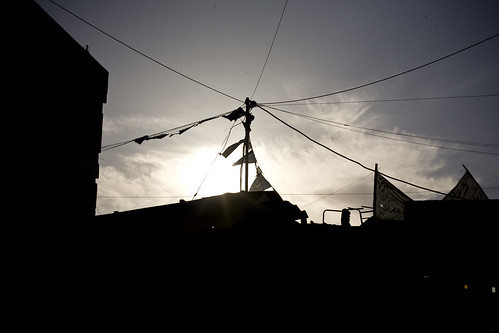
they shouldn't make you nervous
the world is everlasting, it's coming and it's going
--
People are just people.
I read in George Orwell's "The Lion and the Unicorn: Socialism and the English Genius" that people are not just people, that people in England aren't the same people in America or in Germany or in South Africa. But I don't believe George Orwell - and I wonder if at the end of the essay he doesn't refute his own opinion.
I joined Preston and Claire who taught English last night at the Life Center. I had met a few students last week at the party, including Van's brother Ahmed, Zeba and her husband Amir.
The two-hour class is organized into two parts. It's an upper-level class centered on conversation, so each half of each class has a different discussion topic. The first topic was marriage.
What surprised me about our conversation about marriage with Kurds, primarily Muslim Kurds, was that nothing they said surprised me. Every answer sounded American. Everything sounded Christian, and not even ultra-conservative Christian. It sounded like something I've said about marriage or I've heard said about marriage.
Several of the students talked about respect: the husband respecting the wife, and vise versa; the wife respecting her husband's friends, etc. They talked about what they look for in a spouse: education, values, looks, honesty.
--
I'm writing this to expose my ignorance. I assumed a lot about this culture because of the books I read (A Thousand Splendid Suns) or movies (I'll be honest: Aladdin), but I've been wrong.
It's hard to know a culture without being immersed in that culture. I can read all I want, and still not grasp what a people group is all about. I can talk to Jessica and Jeremy about life in Kurdistan, without understanding what life in Kurdistan is really like.
I can't stop thinking of the Incarnation, and what it meant for God to step into our world in order to empathize with us.
He didn't just read about the world or watch movies about it.
He lived in our houses; he "moved into the neighborhood" as Eugene Peterson says.
He put on our skin; he put on our culture (he wore Klash!).
He died a death that we die: political, religious.
So when God says to me, "Girl, I get it. I know what you're going through."
He means it.
I'm beginning to understand that now.
Lauren
[* photo by Lydia Bullock]
Friday, May 28, 2010
Goforth

As you know from my last two posts, I started my Preemptive Love Coalition internship a few days late. (Thanks, Delta.) Tuesday was my first day; Wednesday was my first day in the office.
I love it.
--
Last semester in Dr. Allison's World Lit. class, we read excerpts from 1001 Nights. The overarching story is about King Shahryar, who after he learns that his wife has been cheating on him and his sister-in-law has been cheating on his brother, decides to marry a new woman every night, sleep with her, then kill her in the morning. That way no woman could deceive him.
The daughter of Shahryar's vizier, Shaherazade, devises a plan in order to save the women of her village. She asks to marry the king, but before the king falls asleep, she tells him a story. Each story has a hidden message, about mercy - what the king was unwilling to show his virgin wives.
As dawn approaches, Shaherazade ends with a cliffhanger, enticing enough to keep her alive until she can finish the story. Every night this happens; Shaherazade tells stories within stories within stories to keep the king's interest.
And through this she wins King Shahryar's trust and keeps herself alive.
Jeremy told this story the first day in the office, comparing Shaherazade to us.
As Preemptive Love interns, as marketers, storytellers, representatives, etc. we need to tell a story that's going to keep our audience enticed, like King Shahryar. We're not meant to throw a message at someone and expect them to be instantly moved with compassion. We aren't an infomercial offering something people don't want.
We need to "get permission" first. We need to build relationships; we need to tells stories.
I want to invite you all on this journey with me. I want you to fall in love with Preemptive Love, just like me, but I don't want to shove it in your faces. Come along with me. Read my stories. Look at pictures. Read stories on the PLC blog.
And maybe like Shahryar these stories will change your heart and you'll be filled with compassion. Maybe you'll want to donate money or your time or resources to this organization.
I hope so.
--
I'm trying to figure out why I'm here.
I know I fell in love with Preemptive Love's mission statement in the middle of Dr. Perry's radio production class, during a "break up" with a previous ambition, at the brink of a season of doubt.
But I never felt "called" here ... not in the way I thought people should be called. I remember talking to my roommate Lindsey in January, telling her about this internship and how Mom wasn't cool about it, but how I wanted to do it anyway, and that I wasn't getting a "clear sign" from God.
And then I stopped believing that God calls people the way he had in I Samuel, or in the rest of the Bible. He doesn't speak audibly. He isn't so blatantly obvious about anything.
I never felt called here, but I feel at home. I think of Wendell Berry's character who says, "Often I have not known where I was going until I was already there." I was led, but not in the way I wanted to be led.
Back in December when I read about Preemptive Love Coalition, nothing magically fell into place. It wasn't easy getting my mom on board. It wasn't easy to get my sister and my dad on board either. It was hard figuring out how to apply for a loan, and to write an internship proposal to Dr. Turcott, and fill out my internship app. with PLC.
I spent most of second semester nervous and sick to my stomach and crying all over Mollykins.
Good stories must be fought for. They don't just come. At least, not usually.
"I am a pilgrim, but my pilgrimage has been wandering and unmarked. ... I have had my share of desires and goals, but my life has come to me or I have gone to it mainly by the way of mistakes and surprises. Often I have received better than I have deserved. Often my fairest hopes have rested on bad mistakes. I am an ignorant pilgrim, crossing a dark valley. And yet for a long time, looking back, I have been unable to shake off the feeling that I have been led - make of that what you will." Jayber Crow, p. 133
--
Last night the interns and I went to a party for an ESL class Claire and Preston will start teaching. (Thursdays are Friday nights in Kurdistan; Friday, not Sunday, is the Muslim holy day.)
On the way there, our taxi dropped half of us off at the wrong location. Preston, Alex, Sophie and I wandered around downtown Suly looking for the Life Center, unsuccessfully. We ended up hailing another taxi and driving across town to the right location. Total cost: 7,000 dinar for two taxis on the way there. The first guy over charged us.
At the Life Center, the room was filled with both Americans and Kurds. Sophie and I pulled a chair up next to Lydia, Claire and the two couples they were talking to.
We learned that Zeba and her husband are kitchen interior designers and the other two were both teachers. We talked two Zeba about how she met her husband (he taught her how to rock climb) and how he asked Zeba's mother permission to marry her.
Zeba's going to do our makeup and bake us cake.
We met Van, a university student who's my age. She's spoken English her whole life, and her brother Ahmad is in Claire's class.
After talking and eating Kurdish food - they wrap rice in pickled leaves, weird! - we danced. I like Kurdish dancing because I cannot dance otherwise. Not very well, anyway. Elise, one of the Americans, told us that the key to Kurdish dancing is moving your shoulders. I can do that. You hold hands and do a foot-shuffle thing in a circle.
After the party, we went home and six of us interns stayed up until 1 a.m. playing Scrabble (Go Team Gingers!). Then bed. Then we slept in.
Lauren
Stay connected with PLC on Facebook. (The interns are posting lots of pictures!!)
Tuesday, May 25, 2010
Turkish Delight
I’m writing this in Sulaymaniyah, but I’m going to pretend I’m writing this from Istanbul. I’ll post my first-day-in-Iraq blog when I get to it. Perhaps when the Internet consistently works. (Come on, Lappy.)
--
The flight to Greece was, above all other adjectives (long, tiring, boring, etc.) uncomfortable. I tried to get comfortable, but I couldn't. Even though the seat next to me was free, the 30-something Greek man in seat F to my seat D felt the need to use seat E's tray and seat for storage. Thanks, Mr. Greek Man.
The girl diagonal to me, who was sitting next to a girl with cropped hair -- not her boyfriend (simple mistake, one I corrected only four hours into the trip) -- was reading Willa Cather's My Antonia. Part of me wanted to strike a conversation with her about American literature. The other part of me just wanted to get comfortable.
We watched three movies on this flight: Leap Year, Crazy Heart and Bride Wars. (Lydia asks me: were the movies on your flight good? I rattled off this list. Obvious answer: no.)
The best part of the flight was either the brownie or the plane's approach to Greece. I love the hills in Greece. I wish I had more than two hours there.
Like I said, I loved Greece, but I didn't like having to walk from the bag drop ("You don't have your ticket, go to the Aegean desk!") to the Aegean desk ("You need to talk to Delta. Turn left.") to the Delta desk ("They couldn't just print it out for you?") to the bag drop again. But I got through, got to the gate, talked to my dear sister on Skype, then boarded the plane.
Why I love Greece: on a one-hour flight in the middle of the afternoon, they fed us. They fed us well:
In Istanbul, I got my luggage, went through passport check, got my luggage, and looked for a ride to the hotel. I looked specifically for the hotel shuttle, but it turns out I need my reservation print-out to get a shuttle. At least, that's what the Hertz guy told me. Right before he hit on me.
It was all very charming, not at all as creepy as it sounds.
He walked me to the edge of the parking lot to meet my driver, a Turk with a soul patch. He reminded me of your typical LA business type. He drove a sleek silver car; wore all black. I'm surprised he didn't have a Bluetooth.
Getting my hotel room was frustrating. They made me pay cash (in USD, not Lira, thank goodness. I only had 47 on me).
I got into my room. Played with all the lights. Tried to get a universal adapter to no avail. Took a long, long, long shower. Then crashed for three hours. I woke up, ate Ritz crackers for dinner and watched How I Met Your Mother on my iPod. I was feeling very American.
I read Jayber Crow until Lydia arrived at 1 a.m. Finally someone I know. Or, know through Facebook.
We talked for a little bit. Commented on the mirrors all around the room. (Hmm.) Then went to sleep for three hours.
--
The next day we ate well. The hotel had a free breakfast buffet with eggs, cheeses, pastries, rolls, fruit and sausages. And Turkish coffee. Wonderful, wonderful, wonderful Turkish coffee. I have found true love. Sorry, Starbucks. Sorry, Hawaii. Sorry, Old Crown. (Yeah, I said it.)
I love Turkish coffee.
Lydia and I drove to the airport with the same Turk with the soul patch. We wandered around the airport, got some more coffee - yum! - then sampled every piece of Turkish delight available. I don't get it, Edmund Pevensie, it's not that good.
Then we waited in our gate, discovered our seats were next to each other, road a bus to the plane, got on the plane, ate more food, drank more coffee, got off the plane, had no problems through customs, got picked up by Awara and Jessica, then got settled in Iraq.
More to come, I promise.
Lauren
--
The flight to Greece was, above all other adjectives (long, tiring, boring, etc.) uncomfortable. I tried to get comfortable, but I couldn't. Even though the seat next to me was free, the 30-something Greek man in seat F to my seat D felt the need to use seat E's tray and seat for storage. Thanks, Mr. Greek Man.
The girl diagonal to me, who was sitting next to a girl with cropped hair -- not her boyfriend (simple mistake, one I corrected only four hours into the trip) -- was reading Willa Cather's My Antonia. Part of me wanted to strike a conversation with her about American literature. The other part of me just wanted to get comfortable.
We watched three movies on this flight: Leap Year, Crazy Heart and Bride Wars. (Lydia asks me: were the movies on your flight good? I rattled off this list. Obvious answer: no.)
The best part of the flight was either the brownie or the plane's approach to Greece. I love the hills in Greece. I wish I had more than two hours there.
Like I said, I loved Greece, but I didn't like having to walk from the bag drop ("You don't have your ticket, go to the Aegean desk!") to the Aegean desk ("You need to talk to Delta. Turn left.") to the Delta desk ("They couldn't just print it out for you?") to the bag drop again. But I got through, got to the gate, talked to my dear sister on Skype, then boarded the plane.
Why I love Greece: on a one-hour flight in the middle of the afternoon, they fed us. They fed us well:
- Beef
- Rice
- Lentils
- Gelato
- Roll
- Cheese
- Coke
In Istanbul, I got my luggage, went through passport check, got my luggage, and looked for a ride to the hotel. I looked specifically for the hotel shuttle, but it turns out I need my reservation print-out to get a shuttle. At least, that's what the Hertz guy told me. Right before he hit on me.
Hertz Guy: How old are you?
Me: 20
Hertz Guy: You have boyfriend?
Me: Uh, no.
Hertz Guy: Next time you come to Istanbul, I will be your boyfriend. And your body guard! And your guide.
It was all very charming, not at all as creepy as it sounds.
He walked me to the edge of the parking lot to meet my driver, a Turk with a soul patch. He reminded me of your typical LA business type. He drove a sleek silver car; wore all black. I'm surprised he didn't have a Bluetooth.
Getting my hotel room was frustrating. They made me pay cash (in USD, not Lira, thank goodness. I only had 47 on me).
I got into my room. Played with all the lights. Tried to get a universal adapter to no avail. Took a long, long, long shower. Then crashed for three hours. I woke up, ate Ritz crackers for dinner and watched How I Met Your Mother on my iPod. I was feeling very American.
I read Jayber Crow until Lydia arrived at 1 a.m. Finally someone I know. Or, know through Facebook.
We talked for a little bit. Commented on the mirrors all around the room. (Hmm.) Then went to sleep for three hours.
--
The next day we ate well. The hotel had a free breakfast buffet with eggs, cheeses, pastries, rolls, fruit and sausages. And Turkish coffee. Wonderful, wonderful, wonderful Turkish coffee. I have found true love. Sorry, Starbucks. Sorry, Hawaii. Sorry, Old Crown. (Yeah, I said it.)
I love Turkish coffee.
Lydia and I drove to the airport with the same Turk with the soul patch. We wandered around the airport, got some more coffee - yum! - then sampled every piece of Turkish delight available. I don't get it, Edmund Pevensie, it's not that good.
Then we waited in our gate, discovered our seats were next to each other, road a bus to the plane, got on the plane, ate more food, drank more coffee, got off the plane, had no problems through customs, got picked up by Awara and Jessica, then got settled in Iraq.
More to come, I promise.
Lauren
Subscribe to:
Posts (Atom)